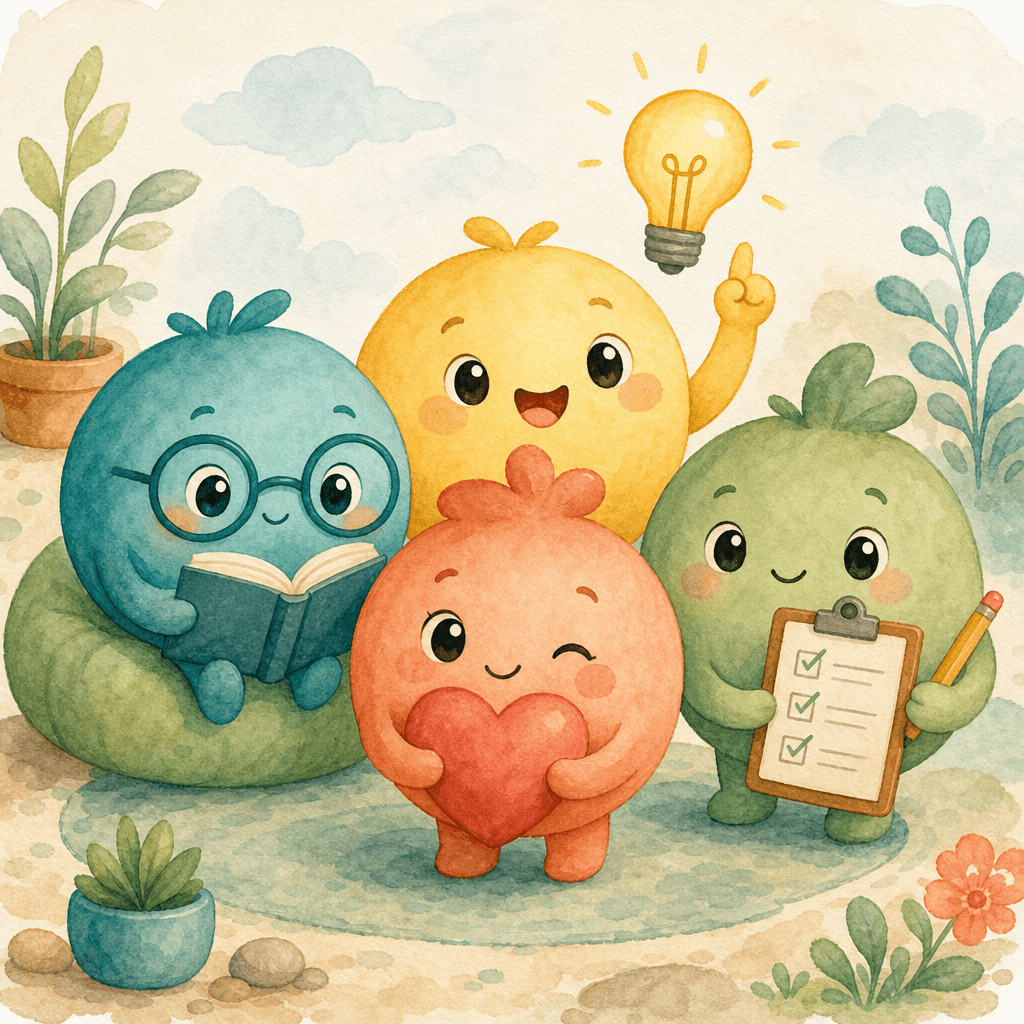
Answer light questions for a playful personality-style snapshot—fun conversation, not science.
Personality Type Quiz
A small map for understanding yourself—start drawing it today
Where does your energy come from? How do you take in information? What guides your decisions? Following these four preferences can help you understand yourself—and the people around you—a little more gently.
As Korean culture reaches more people around the world, many are curious about everyday life in Korea. Personality-type quizzes like this are hugely popular there—most people try one at least once. Give it a go and see why.
The 16-type preference framework builds on Carl Jung’s psychological types, adapted by Katharine Briggs and Isabel Myers into an accessible self-report way to explore personality in everyday life.
It starts from the idea that people differ in how they perceive and decide, and looks at which side of each preference pair you’re drawn toward.
It isn’t a test of right and wrong or of ability—it’s best used as a starting point for understanding yourself.
Four dimensions
We look at which side of each preference pair you’re drawn toward and summarize that as one of 16 types. These are natural leanings—not rankings of skill or worth.
Extraversion (E) · Introversion (I)
Where energy flows
Are you closer to gaining energy from people and activity outside yourself, or from quiet thought and inner depth? Either way, this isn’t a “sociability score”—it’s about where your energy comes from.
Sensing (S) · Intuition (N)
How you take in information
Sensing focuses on facts, experience, and what’s here and now through the senses. Intuition is drawn more to meaning, patterns, and possibilities behind the facts. It’s about what you notice first.
Thinking (T) · Feeling (F)
How you decide
Thinking tends to sort judgments through logic and consistent principles. Feeling weighs people, relationships, values, and impact before landing on a conclusion. It’s about what you use as your yardstick.
Judging (J) · Perceiving (P)
How you meet the outer world
Judging often prefers planning, deadlines, and wrapping things up. Perceiving likes keeping options open and adapting as the situation unfolds. It’s a style of how you handle everyday life.
Why take it?
Self-understanding
Putting a name to the choices and reactions you keep repeating can help you ask “why do I do this?” with a little more kindness.
Communication
Seeing different preferences as another path—not the wrong one—can leave more room for fewer misunderstandings.
Work & career reflection
It can hint at which environments energize you and which ways of working feel natural. (It doesn’t replace aptitude testing or hiring decisions.)
Relationships
Conflict or distance with people close to you may come not only from clashing values, but from different preferences.
About eight minutes is enough
No account needed—48 questions to explore your preference type.
People enjoy short quizzes that mirror habits and preferences. This personality-style quiz serves that curiosity with quick prompts and a readable result card meant for amusement.
It is not MBTI® certification, not a clinical instrument, and not career counseling. Professional assessments—when warranted—belong with licensed practitioners using validated tools.
For a more meme-flavored internet quiz, try Egen–Teto. For organizing real goals after you close the tab, mind-map tools are a better use of time.
How to use
Launch the quiz — Open the personality quiz page and start when ready.
Respond to each prompt — Choose the option closest to your usual preference—or your mood today.
Submit the set — Finish all items to unlock the summary.
Read with a grain of salt — Treat the write-up as entertainment copy, not a verdict on your identity.
Optional share — Send to friends for laughs, or close the tab and get back to work.
Use cases
Icebreakers — Spark light discussion in social or classroom warm-ups (kept clearly non-serious).
Solo amusement — Pass a few minutes with reflective-but-playful prompts.
Content banter — Streamers and creators can react to results as jokes, not advice.
Tips
Entertainment only—never use results for hiring, dating filters, or medical choices.
If a question feels uncomfortable, stop; it is optional fun.
Avoid over-identifying with a label you saw on a free webpage.
Channel leftover curiosity into journaling or a mind map of real goals.
FAQ
Is this a real psychological test?
No. It is an entertainment quiz without clinical or hiring validity.
Do you diagnose conditions?
Absolutely not. Seek licensed professionals for mental-health concerns.
Account required?
No account is required to try the quiz.
Will results be emailed?
Typically you read them on-page; nothing sensitive should be typed into casual quizzes.
Similar to Egen–Teto?
Both are entertainment. Flavors differ; neither is scientific.
Related tools?
egen-teto for another fun quiz; mind-map-maker if you want productive planning next.